


I became a mother in March and went back to work in June. On paper, it should have been the least productive season of my career. It's been close to the most, and I finally think I understand why.
It’s 4 a.m., and I’m feeding my son with one arm while reading through a product backlog with the other. I want to be clear that this is not a productivity flex. I would love to be asleep. But somewhere in these strange, quiet, sleep-deprived hours over the last few months, I noticed something I genuinely did not expect: I’m getting more done, and thinking more clearly, than I did back when I had all the time in the world.
I became a mother in March. I went back to remote work in June. And in the middle of all that, while learning to run on far less sleep than I thought a person could, I kept my full-time job going, kept a newborn alive and happy, and on the side started building Minilu, the baby-tracking app I never planned to make until he arrived and I suddenly, urgently needed one myself. Three things at once, on a fraction of my old hours. Every logical prediction says that should have flattened me. Instead, it sharpened me. I’ve been trying to understand why, because it runs against almost everything we’re told about mothers and work.
The old version of me had all the time and less reason to guard it
A year ago I had long, open-ended afternoons, and I used them more loosely than I do now. “I’ll get to it later” was a real sentence I said to myself, and later usually did arrive. But a thirty-minute job could quietly stretch to fill an afternoon, mostly because nothing was forcing me to decide what mattered first. Having plenty of time wasn’t a flaw. It just never made me choose.
Now every workable block is about twenty-five minutes wide, and I can see the edges of it before it starts. When your son might wake up at any moment, you stop opening seventeen tabs “to think.” You pick the one thing that moves the needle, and you do that. The constraint didn’t slow me down. It did the one thing all those open afternoons never had to: it made me choose.
Watching someone develop from zero develops you too
There’s a part of this I can’t reduce to time management. Watching a human being grow from literally nothing, from not being able to hold her own head up to recognizing my face and deciding it’s her favorite thing in the room, does something to you. It rewires how you see progress, patience, and what “good enough for today” means.
It turns out that isn’t just a feeling. Neuroscientists have a word for it: matrescence, and the research on it is striking. Becoming a parent reshapes the brain’s default mode network, the system tied to planning, self-reflection, and reading other people. One large study of nearly 28,000 adults even found that parents tend to have “younger-looking” brains in mid- and later life than people without children, and researchers think it’s the daily cognitive workout of caregiving, not pregnancy alone, that does it. Which lines up almost too neatly with how I feel: like some part of me is being trained every single day, and my work is quietly borrowing the results.
The part that made “all three at once” possible
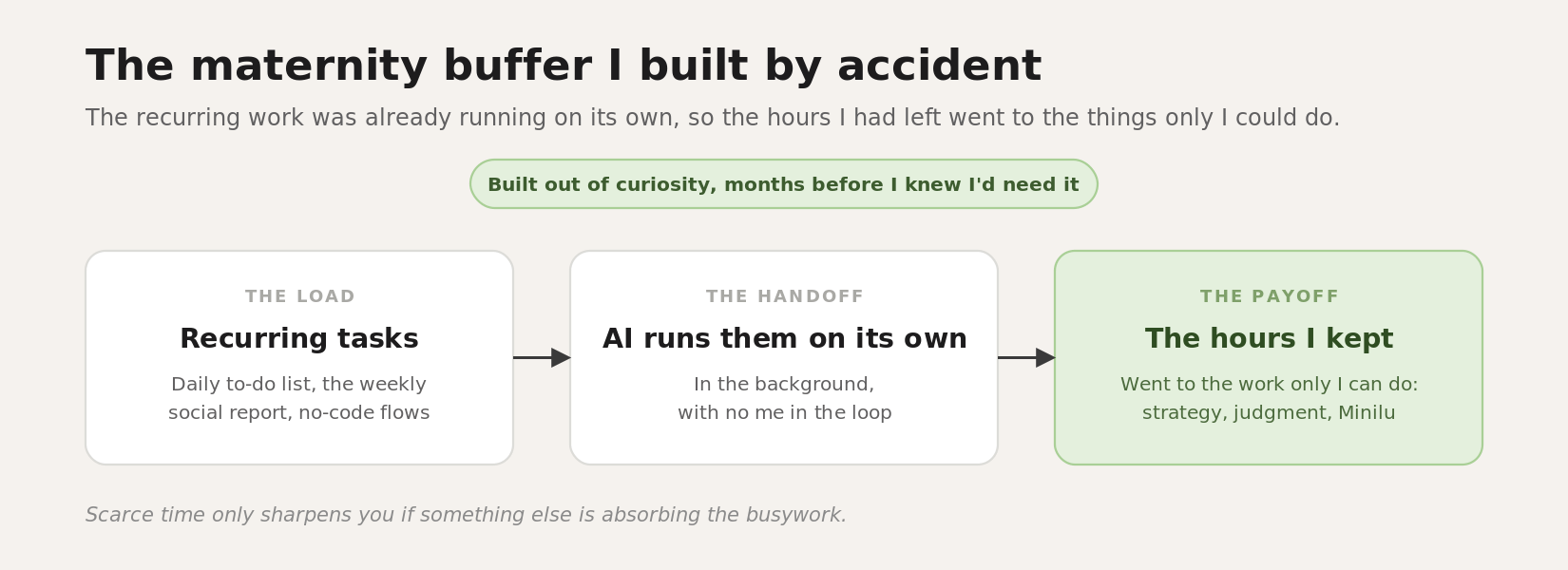
I’ll be honest about the piece that carried the load, because it’s the whole reason the math worked: the recurring, unglamorous parts of my job mostly run themselves now. Over the past months, I’d handed a lot of them off to AI, from the daily task ritual I used to retype every morning to the weekly social report that used to eat half a day, plus the no-code workflows humming along in the background of my week.
I built those before my son arrived, mostly out of curiosity. I had no idea I was actually building myself a maternity buffer. When the hours got scarce, the work that didn’t need a human simply kept happening without one, and the hours I did have went to the things only I could do: the strategy, the judgment calls, the parts of Minilu that needed an actual person who understood both the product and the exhausted parent using it at 4 a.m. Scarce time only sharpens you if something else is absorbing the busywork. For me, that something was the automations.
The penalty that turned out to be a premium
We have a name for what’s supposed to happen here. It’s called the “motherhood penalty,” the well-documented assumption that once a woman has a child, she becomes a less committed, less capable employee, and gets quietly passed over for it. I braced for some version of it in myself. I kept waiting to feel dumber, slower, less serious about work.
The opposite happened, and the research is starting to catch up to why. A 2026 study in the Journal of Applied Psychology found what the authors bluntly called a “motherhood advantage”: parents, and especially mothers, tend to attach more meaning to their work. They see it as a way to prove something to their families, and their supervisors independently rated them as putting more effort in, not less. The penalty is real as a bias. It is not, apparently, real as a fact about the work.
What I’m taking from this
Here’s the one thing I’d hand to anyone staring down a season where their time is about to collapse, whether that’s a new baby, a new caregiving role, or a new anything: a hard constraint won’t wreck your output the way you fear, as long as two things are true. You need a reason that makes the remaining time non-negotiable, and you need to have already offloaded the work that doesn’t require you. Constraint plus purpose plus a cleared plate isn’t a recipe for burnout. In my experience, it’s the most focused I’ve ever been.
I don’t think less time made me better. I think less time forced me to finally act like the things I said mattered actually did.
So I’m curious, and I mean this as a real question: when in your life did having less somehow make you sharper, whether it was less time, less budget, or fewer people, and what did that season teach you that abundance never did? Hit reply. I read every one.
Until next Monday,