


Last week I wrote about the first thing I automated with Claude, a small morning ritual involving a Slack bot named Komuncan and a to-do list I was tired of retyping. I said there’d be more of these. Here’s the second one, and this time the difference wasn’t about memory or organization. It was just about getting back hours in my week.
The ritual
Every week, and again at the start of every month, I put together a social media report. Numbers come in from a few different platforms. I’d sit down, pull them together, drop them into a Canva deck one slide at a time, double-check I hadn’t mixed up a number between platforms and then came the part that actually took focus: making sense of what those numbers meant and writing a short executive summary at the top, before exporting the whole thing as a PDF and posting it to our growth channel with a short note.
I never actually timed it until I thought about writing this. When I did the math, it landed somewhere around half a day. Not because any single step was hard, because there were a lot of small steps, and one of them (the summary) genuinely needed me to think, every single week, without fail.
What actually changed
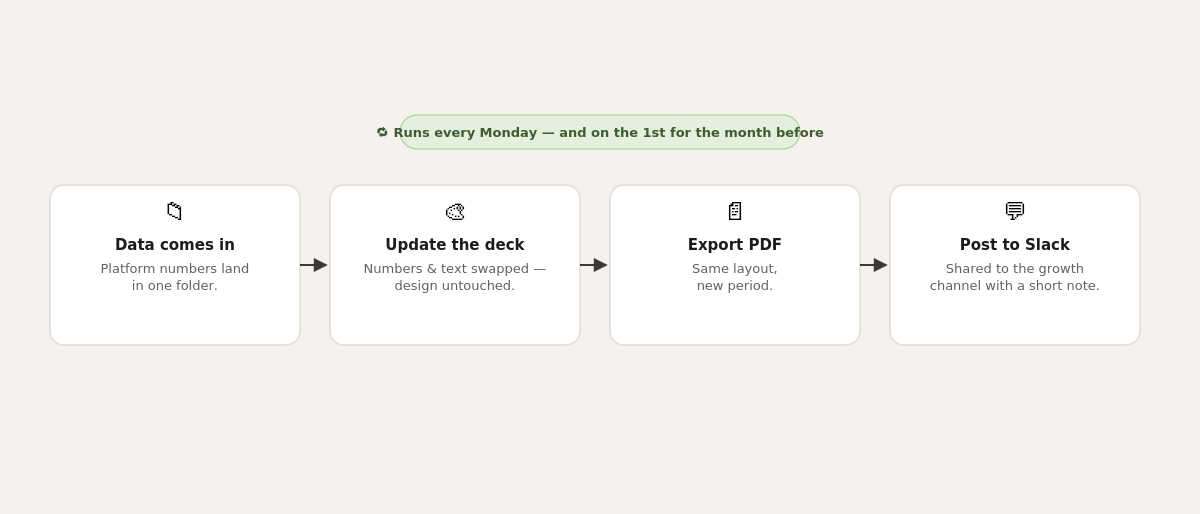
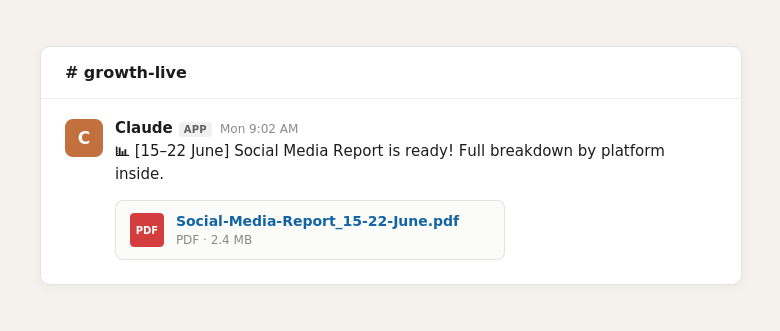
That whole loop, reading the numbers, working out what actually moved and what it might mean, drafting the executive summary, updating the deck, exporting, sharing it in Slack, now runs on its own. Practically, it runs through Claude Cowork: it pulls that period’s data, opens the actual Canva deck and edits it directly inside Canva, exports the result as a PDF, and posts it into our Slack channel, the same sequence I used to do by hand, minus me sitting there for all of it. Every Monday for the week before, and on the 1st of the month for everything before that. I still open the result and glance at it before I fully move on with my day. That takes about half an hour, mostly out of habit.
Half a day down to half an hour. That’s the whole story, honestly, more than any clever technical detail about how it works.
What I’m taking from this one
The first automation I built saved me a small daily annoyance. This one saved me actual hours, every single week, that I used to just accept as the cost of the job. I hadn’t clocked how much of my week this one task was quietly eating until it stopped eating it. And honestly, I didn’t expect the part I’d have to think through the summary, the “what does this actually mean” part, to be the part that got handed off too. I assumed I’d still be doing that bit myself.
I think that’s the real thing I’d tell you to look for in your own week: not the task that annoys you the most, but the one you’ve stopped noticing takes as long as it does, because you’ve been doing it that way for so long it just feels like “part of the job.”
Two down, and this is the one that’s actually changed how my week feels. Mondays used to have a report hanging over them, and now they mostly don’t.
If you’ve got a report, a deck, or anything recurring that quietly eats half a day of your week, I’d genuinely like to hear about it. Hit reply.