


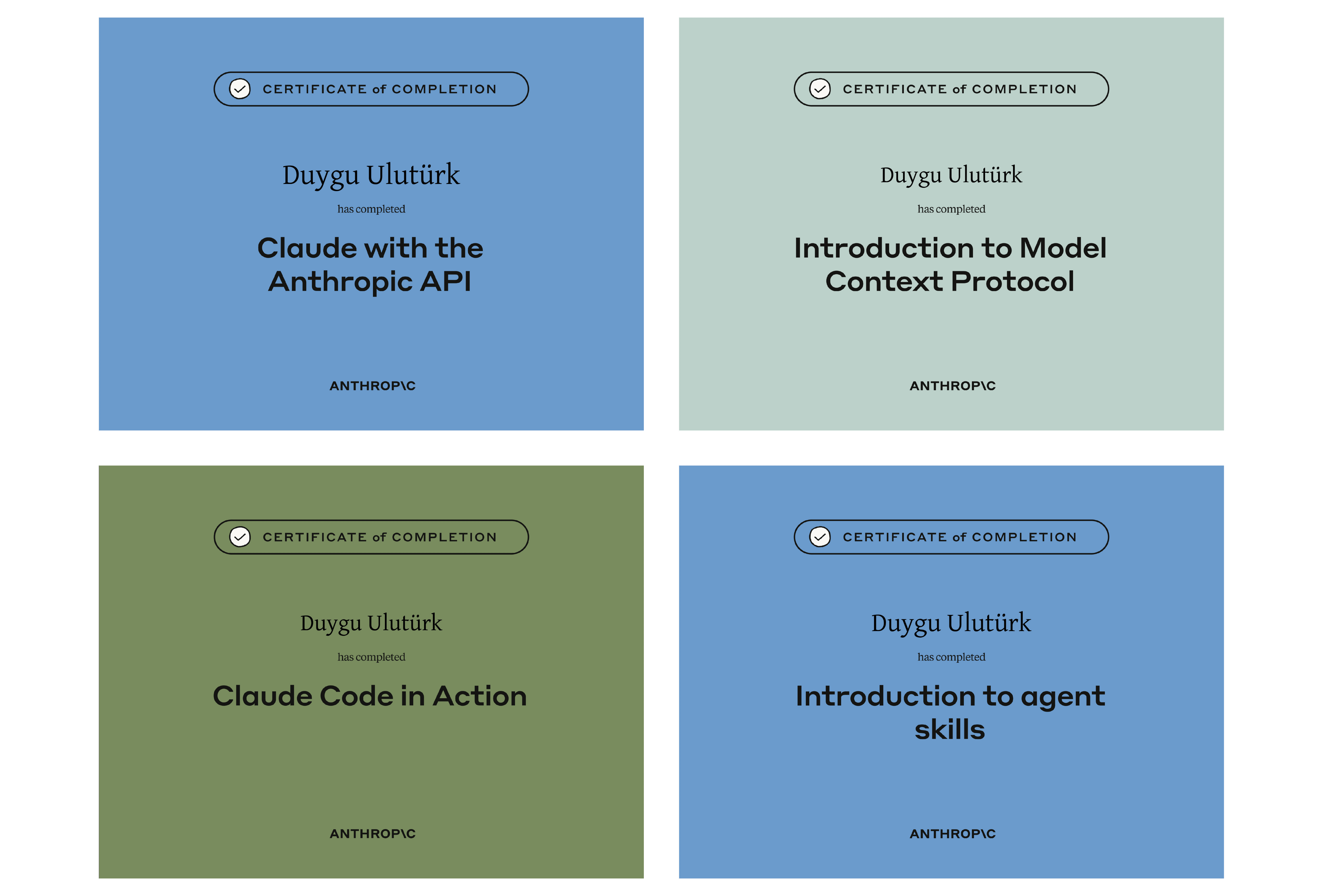
Over the past couple of weeks, I did something a little unusual for someone who has spent the last 14 years running marketing teams and building agency strategy. I went back to the classroom to take four official technical courses from Anthropic.
I wrapped up certificates in Claude with the Anthropic API, Introduction to Model Context Protocol, Introduction to agent skills, and Claude Code in Action.
You might be wondering why a marketing leader is spending their time learning about context protocols and command-line interfaces instead of, say, the latest TikTok algorithm update.
Here is the truth: we’ve hit a ceiling with the traditional AI chat interface.
Typing a prompt into a web window and waiting for a response is fine for brainstorming an email subject line or outlining a blog post. But when you want to build actual marketing operations, systems that categorize thousands of customer feedback tickets, generate localized ad variations on the fly, or automatically pull competitive pricing, copying and pasting doesn’t scale. I wanted to understand how to move AI out of the chat window and wire it directly into the plumbing of my campaigns.
Learning the Anthropic API showed me how to programmatically send and receive data, bypassing the manual interface entirely. The agent skills course was a massive lightbulb moment: it’s about giving the model actual tools. Instead of just asking Claude a question, you can give it the ability to search your product database, read a live webpage, or trigger an email sequence.
The Model Context Protocol (MCP) was particularly interesting for B2B and SaaS. In marketing, our biggest hurdle with AI is context. The model doesn’t inherently know our brand guidelines, our past campaign performance, or our highly specific customer segments. MCP provides a secure standard for connecting these models directly to our private data sources without compromising security. And Claude Code? It showed me how AI can sit right inside a development environment to handle repetitive technical tasks, bridging the gap between what marketing wants and what engineering has to build.
By understanding the technical constraints and capabilities of these systems, I discovered that everyone can design significantly better marketing workflows. I don’t necessarily want to become a full-time software engineer, but knowing exactly how the pipes connect means I can architect processes that actually work, rather than just throwing vague ideas at my team.

If you want to start shifting your marketing team from “prompting” to “system building,” here is how to start thinking about it:
Audit your copy-paste loops: Spend a week writing down every time you or your team manually copies data out of a tool, pastes it into an AI chat window, and copies the result back. These are your prime candidates for API automation.
Define your required “tools”: When an AI struggles with a marketing task, it’s usually because it lacks access to real-time information. Ask yourself: what tool does it need to finish the job? A calculator? A web scraper? A CRM lookup? These are “agent skills” you can build.
Use AI as a router, not just a writer: Some of the best marketing use cases have nothing to do with generating content. Use the API to read incoming lead data, structure it, and route it to the right sales rep based on context.
Talk to your developers differently: If you understand the basics of APIs and how context windows work, you can write far better technical briefs. You stop asking for magic and start asking for specific data flows.
Let’s look at a concrete scenario. Suppose you run a SaaS company and want to track feature requests from support tickets to inform your next product marketing push.
The old way: Every Friday, a junior marketer exports a massive CSV from Zendesk, pastes chunks of it into an AI chat window, and asks for a summary of feature requests. It takes two hours, the context window constantly breaks, and the output format changes every single week.
The system way: You set up a simple script using the Anthropic API. Every time a ticket is tagged “feedback,” the script sends the text to Claude with strict instructions to extract the feature request, assign it to a predefined category, and return the data as a clean JSON file. That data then populates directly into a live dashboard. No humans copying text. No inconsistent formatting. Just a quiet engine running in the background.
Learning the technical side of these tools was a bit humbling at times, but it completely changed how I look at marketing automation. We are moving from a world where we “talk” to AI to a world where we build with it.
I’m curious about what repetitive, manual marketing task you wish you could just wire an agent to handle in the background? Hit reply and let me know. Let’s see if it’s possible to build it.
Until next week,