


The first two entries in this series were about tasks I was glad to get rid of: a morning to-do ritual I kept retyping, and a weekly report that quietly ate half my day. Easy calls. Nobody’s precious about a status update.
This one is different because it’s about the thing I actually like doing. Writing. Which is also, somehow, the thing I could never manage to do on schedule.
Here’s the honest version. I love writing. That’s the whole reason this newsletter exists. But loving something has never once protected it from a busy week. Every time work got heavy, the newsletter was the first thing to slide, because it was the only item on my list that no one else was waiting on. “I’ll write it this weekend” turned into three skipped weeks more times than I want to admit. So the task I audited this time wasn’t a chore I hated. It was a thing I loved, but I kept losing it to everything more urgent.
I didn’t want to automate the writing. I wanted to remove everything around the writing that made it too heavy to start.
The ritual
Putting out one issue, the old way, looked like this.
I’d open a chat and ask for help with a draft, and get back something technically about my topic that sounded nothing like me: that flat, everything-is-a-bulleted-list, “in today’s fast-paced world” voice. So I’d spend twenty minutes re-explaining who I am: first person, no corporate throat-clearing, short sentences mixed with long ones, open on one small concrete thing, not a grand claim. Every single time, from scratch, like the last conversation never happened.
Then, once the piece was done, the other jobs started. Read it back and figure out what was actually worth pulling out. Write two or three short Notes to get people to read it. Write a LinkedIn version that isn’t just a pasted-in article, because that reads like a robot on LinkedIn. Make a cover image that doesn’t look like a stock-photo handshake. Each one a separate sit-down, each one me re-describing my taste to a blank box that didn’t remember it.
None of those steps were hard. But stacked together, on a busy week, they were heavy enough that “not this week” was always the easy answer. That’s the real thing that was killing my regularity. Not the writing, the weight around the writing.
What actually changed, and how it works
I’ll get concrete here because the how is the point of this one.
All of it runs in Claude Cowork. Think of it as Claude with hands: it can open my files, run steps in order, and keep working in the background instead of just answering in a chat. The important part isn’t the chat window. It’s that I can teach it something once and it stays taught.
The way you teach it is with skills. A skill is just a set of written-down instructions Claude loads when it’s relevant: your standards for a task, saved in a file instead of in your head, so you never have to re-explain them. I built three, one for each part of the loop that used to be manual.
The first is newsletter-writing, and this is the one that mattered most. It holds my voice. I built it the slow, unglamorous way: I fed it my own past posts and said this is the person you’re writing as. I added a short list of writers I actually like reading and said this is the neighborhood I want to live in; don’t copy them, just aim here. And then I corrected it, a lot. “Too formal.” “You stated a rule I’d never say out loud.” “This bullet list should be a sentence.” The difference from a normal chat is that every correction went back into the skill, so it stuck instead of evaporating when I closed the tab. After enough passes, drafts started coming back sounding like me on a good day. Still needing my hand, but starting from me instead of from nobody.
The second is substack-growth, and this is the analysis part. Once an article is finished, it reads the actual piece (not a topic, the real text) and works out which lines carry the idea, which are quotable, and what the hook is. From that, it drafts the Notes, the LinkedIn version, and a few alternative titles and subtitles, all in the same voice the first skill already knows. So the distribution isn’t a second creative project from a cold start; it’s the piece I already wrote, broken down and re-angled for each place it needs to live.
The third is blog-visual-mockups, which handles the images: cover art, simple diagrams, the occasional mocked-up screenshot, so I’m not fighting a design tool at the end of every issue.
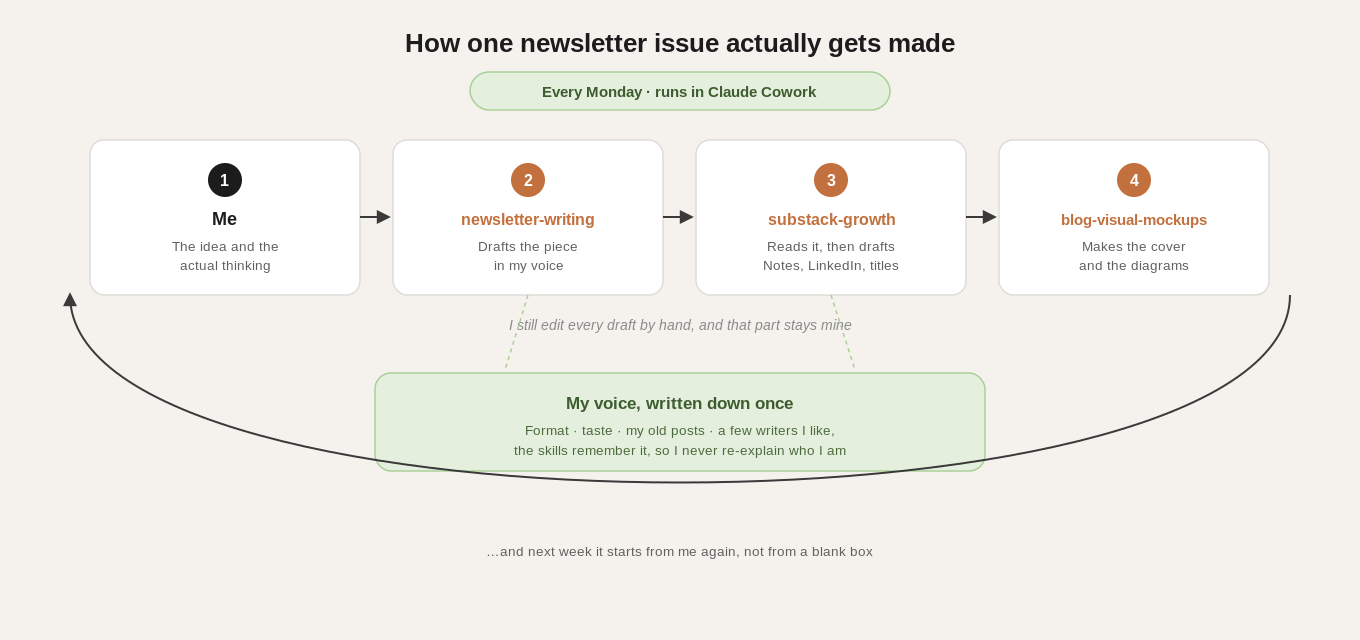
Put together, the process now looks like this: I bring the idea and the actual thinking. The first skill drafts it in my voice. I edit by hand. That part is still mine, and I want it to be. Then the second skill turns the finished piece into everything I need to publish it, and the third makes the visuals. What used to be one heavy afternoon-that-kept-not-happening is now one focused writing session plus a review pass.
And I’ll be honest with you: this post ran through that exact system. I still went back in and rewrote lines by hand because some of them weren’t right. That’s the arrangement now, and I’m oddly fine with it.
What I’m taking from this one, and what you can steal
The first two audits taught me to look for the boring task. This one taught me to look at the task I love and ask a different question: not “how do I do this faster,” but “what’s the weight around this that keeps me from doing it at all?”
Because the fix here wasn’t a machine being me. It was me writing my taste down once (my voice, my format, my standards) in a place that remembers, so the energy I used to spend re-explaining who I am goes back into the only part that was ever really mine: the thinking, and the line that only lands if I write it.
If you want to try the same thing, the transferable version is small: pick one recurring piece of your own work, and instead of describing how you want it done this time, write those instructions down somewhere reusable. Feed it real examples of your own past work, correct it until it’s right, and keep the corrections. That’s the whole trick. Not “automate the thing.” Teach it your taste once, so it stops asking.
Three down. This is the one I was most afraid of, and it turned out to be less about giving something up and more about finally being able to keep a promise to myself to write every week.
If there’s something you love doing but keep failing to do regularly, I’d genuinely like to know what it is and what the actual weight around it is. Because I’d bet it’s not the part you love. Hit reply.
Until next week,