


I’m going to be honest with you. There is nothing scarier in my career than a blinking cursor on a Monday morning.
We’ve all been there. It’s 9:00 AM. You have a massive deliverable due, a strategy deck, a migration plan, or a high-stakes launch email. You sit down, crack your knuckles, open a fresh Google Doc… and stare.
Suddenly, reorganizing your Chrome bookmarks by color feels incredibly urgent. Or maybe you decide it’s the perfect time to audit your entire Notion workspace. (Guilty.)
This is “Blank Page Syndrome,” and for years, it absolutely paralyzed me.
Most marketers try to solve this by opening ChatGPT and typing: “Write a marketing strategy for a B2B SaaS company.”
And what do they get?
“In today’s fast-paced digital landscape...”
Generic, soulless, corporate fluff. It sounds like everyone else because it is everyone else. It lacks your nuance, your context, and your specific constraints.
But recently, I stumbled on a workflow that completely changed how I start big projects. I call it the 15-Minute Journalist Method.
It turns “chaos” into “clarity” before my second cup of coffee is cold.
The Core Shift: AI as an Interrogator, Not a Writer
The mistake we make with AI is treating it like a Junior Copywriter (”Here is a topic, write this for me”).
Instead, you need to treat it like a Ruthless Journalist (”Here is my messy brain; interview me until it makes sense”).
You already have the strategy in your head. You have the messy notes, the shower thoughts, the 3 AM anxieties, and the gut feelings about why the current plan is failing. You just don’t have the structure.
So, stop trying to write. Start talking.
The 15-Minute Protocol
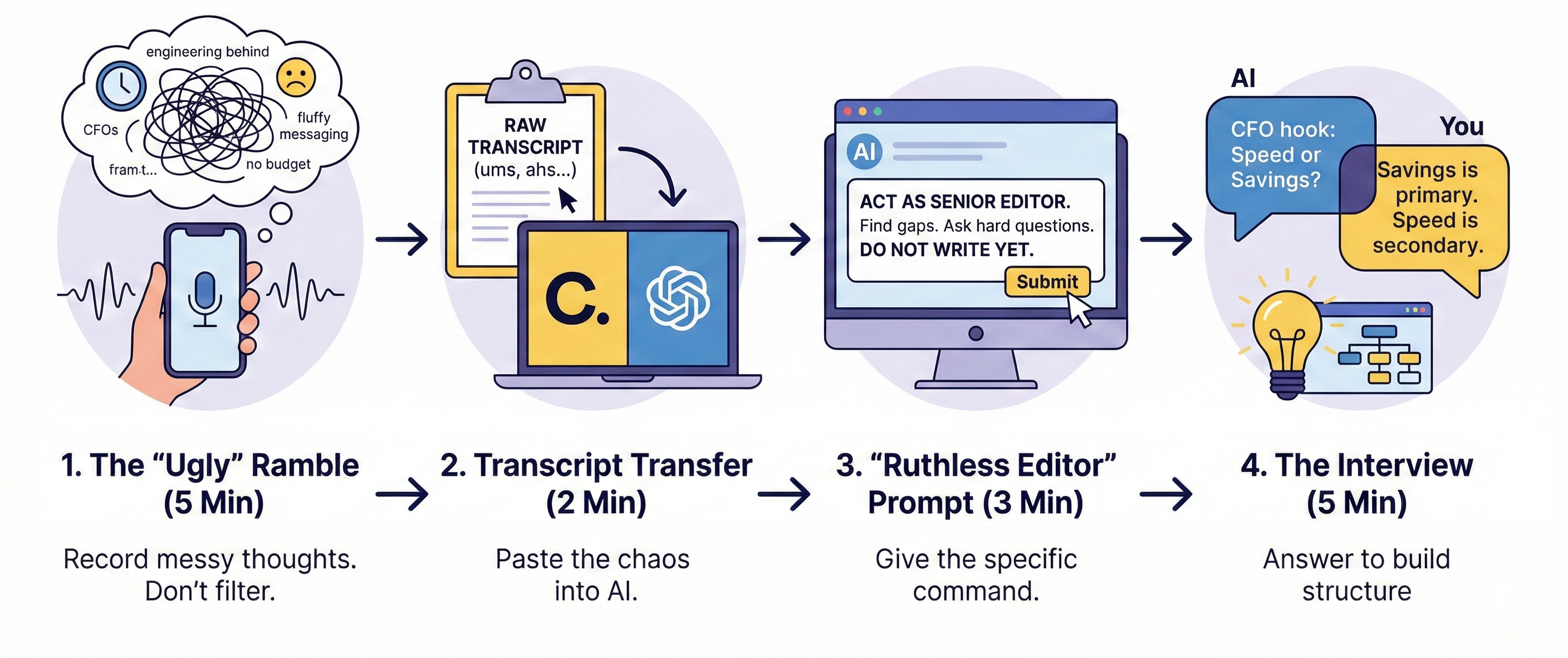
This is the exact workflow I used last week to draft a Scope of Work that I had been avoiding for three days.
Step 1: The “Ugly” Ramble (5 Minutes) Close your laptop. Open the voice memo app on your phone (or use a tool like Otter.ai or AudioPen).
Hit record and just talk.
Do not filter yourself. Do not try to sound smart. Vent about the project. “Okay, we need to launch this feature by March, but the engineering team is behind. We need to target CFOs, but I’m worried our messaging is too fluffy. It needs to be serious about ROI. Also, we have no budget for paid ads, so we need a heavy organic play...”
Get it all out. The messier, the better.
Step 2: The Transcript Transfer (2 Minutes) Take that raw, rambling text transcript. It will look terrible. It will be full of “umms” and half-finished sentences. That is perfect.
Paste it into your AI tool of choice (Claude is my favorite for this because it handles nuance well, but ChatGPT-4o is great too).
Step 3: The “Ruthless Editor” Prompt (3 Minutes) Do not ask it to write the draft yet. If you do, it will hallucinate details you didn’t provide. Instead, use this specific prompt:
“I am going to paste a raw brain dump for a [Strategy Document / Email / Campaign].
Do NOT write the draft yet.
Instead, act as a senior editor. Read my notes, analyze my logic, and identify the gaps. Then, ask me 3–5 specific, hard questions to clarify the direction. Force me to make decisions.”
Step 4: The Interview (5 Minutes) The AI will come back with questions like: “You mentioned targeting CFOs, but your notes focus on ‘speed of implementation.’ Do CFOs actually care about speed, or do they care about cost savings? Which is the primary hook?”
This is the magic moment.
When you answer these questions, you aren’t “writing”, you’re solving problems. You’re making strategic choices in real-time.
Once you’ve answered the questions, give one final command: “Okay, now summarize our conversation into a structured outline.”
Boom. You have a solid, logic-tested structure. The blank page is dead.
Why this works
When I first tried this, I realized something painful: I wasn’t procrastinating because I didn’t know how to write. I was procrastinating because I didn’t know what I thought yet.
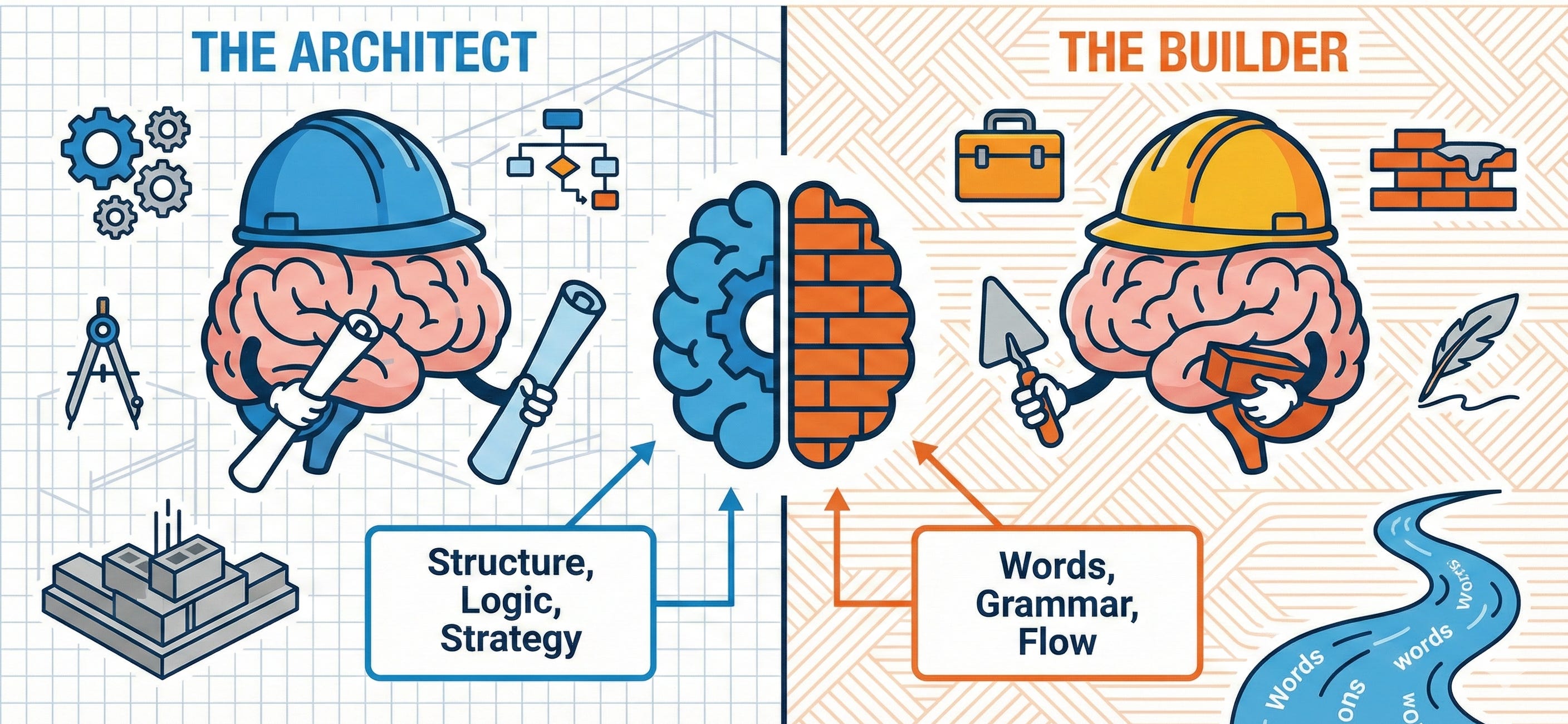
Writing requires two different brain modes:
The Architect (Structure, logic, strategy)
The Builder (Words, grammar, flow)
Trying to do both at once is exhausting. This method separates them. The “Ramble” lets you be the Architect without worrying about the bricks. The “Interview” forces you to stress-test your blueprints.
A Quick Example
I was recently working on a positioning doc for a client in the fintech space. I was stuck. I kept typing “We help companies save money...” and deleting it.
I did the Journalist Method.
I rambled into my phone while walking the dog. I fed it to Claude.
Claude asked me: “You kept saying ‘we’re different because we’re transparent,’ but you didn’t give a single example of transparency. What is a specific transparent practice you do that competitors don’t?”
That question stopped me cold. I realized we didn’t actually have a differentiator yet. We had to go back to the product team and build one (a live dashboard for fees).
If I had just forced myself to “write the copy,” I would have written a vague, weak marketing claim. The process forced the strategy to get sharper.
Try this today
If you have a task on your to-do list that you’ve migrated from Monday to Tuesday to Wednesday... try this:
Stop typing. Pushing keys isn’t working.
Dictate for 3 minutes. Use your phone. Pace around the room.
Get interviewed. Let the AI find the holes in your thinking.
You’ll be surprised how fast you can get to a “Draft 1” that actually feels like you.
Question for you: What is your favorite way to “waste time” when you’re avoiding a big project? (Aside from color-coding spreadsheets, which is clearly productive work... right?)
Hit reply and tell me.
See you next Monday,